After 'wintering' in Australia and missing all the rain and damp, dreary weather, it was time to brave the elements once more.
'Where to?' I asked.
Strictly Lady Lloyd had the answer: a circular walk that she'd done a few years ago from Holmwood Station to Leith Hill. A nice little 10km trek to ease us back into the swing of things. So we switched our usual South Downs destinations for the Surrey Hills and, since she also offered to take care of the weather, the sun shone brilliantly for us on Saturday and the skies were clear.
As SLL pulled up at our house, I was in the middle of a lost-key debacle with Hearth-Father, so made a welcome escape from domestic duty. When you begin the journey with a rant, as I did, it's a clear sign that a walk is long overdue.
The narrow path at the start was very muddy indeed, and required a kind of wide-legged snow-plough action to navigate it without wellies. Any initial mud will quickly clear our route-guide promised, though it took a little while before we made it to solid ground. When we did, we passed some impressive houses before reaching grassy meadows, contented sheep, and some great views.
Through the woods, our path snaked its way past Astiebury Hill Fort. The scenery looked somehow alien, although perhaps it was the time of year. Given that we were heading to Leith Hill, the highest point in the southeast of England, it is perhaps unsurprising that much of the first part of the walk was mostly climb, certainly from Coldharbour up to the tower.
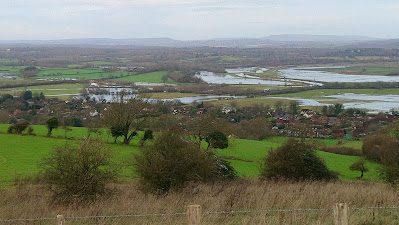
But the good thing about a climb (aside from the descent) is that it often comes with great views and this walk was full of them. We paused a while on the ascent from Coldharbour to break for the traditional granola fuel.
We passed the 'highest cricket pitch in Surrey' before heading onto the National Trust's Heathland Trail for part of the route.
The day seemed to be dominated by trees. Fairytale trees with big, gnarly, moss-covered trunks, like dragon-feet, or muscular limbs that might belong to Tolkein's benevolent Ents.
Roots that might have been found at the foot of the magic faraway tree, or boughs like intertwined bodies.
In glorious sunshine of early spring, before their foliage is back to full growth, and above a carpet of mulching leaves, the trees were stunning. It was also a walk where the scenery and terrain continually changed, leading SLL to remark, 'I remember this bit!' at frequent intervals.
At Leith Hill Tower, we stopped for coffee and a slice of bakewell tart to go with lunch. Bakewell tart is an unfortunate weakness for both of us, so if it's on the menu, away go the emergency Wispa bars and an altogether better sugar-fix is called for.
The tower dates from the late eighteenth century and was apparently constructed to raise the height of the hill to the height of 1000ft. According to the National Trust website, it was a personal project undertaken by Richard Hull from Leith Hill Place as 'a place for people to enjoy the glory of the English countryside'. Hull apparently loved the tower so much he wanted to be buried underneath it.
The tower itself is still closed for its winter break, so we weren't able to climb the staircase inside, but we could sit for a while and just enjoy the views of sweeping countryside (while trying to avoid being distracted by the large number of dogs that seemed to be gathered at the top).
After our little break we took a very steep descent from the tower. Perfectly manageable, according to the walking guide. More than a little on the precarious side might be a more accurate description, we decided, as we traversed the slope, clinging onto trees wherever we could.
Very possibly it was 'perfectly manageable' if the ground was drier underfoot. The pictures don't really do it justice - or else they just make us look like wimps.
Eventually we passed a sign for Mosses Wood, and a plaque to say that it had been given to the National Trust by Lady Editha Ivy Pigott-Brown of Broome Hall as a memorial to her son John killed in 1942 in Tunisia. There was a snorting-horse incident somewhere along the way, though not quite as scary as some of our cow-encounters on previous walks, and we survived to tell the tale.
All too soon we were back in Beare Green, but this was a truly delightful way to spend a Saturday afternoon. SLL and I are now refreshed and ready for whatever life decides to throw at us in the next few weeks, until one or other of us is screaming for the hills once more.



Comments
Post a Comment